
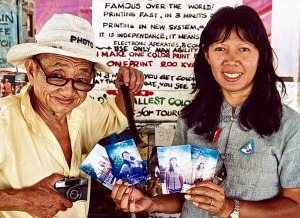
 At Bagan we met a colourful and eccentric little fellow called Mr Sein Win who was a temple photographer at Schezigon Pagoda. Mr Sein Win was engaged in a battle to keep the art of photography using film, alive. At that point in time the battle for supremacy between conventional film and digital photography was in its last stages. Film still had a staunch legion of supporters, but the writing was on the wall. However, there was no doubt in Mr Sein Win’s mind as to which was the better of the two mediums. He had spent the last thirty five years recording the adventures of tourists visiting the Schezigon Pagoda on good old traditional, tried, tested and reliable 35mm film.
As we approached the pagoda via a long covered walkway, we couldn’t help but notice his colourfully decorated darkroom among the vast array of vendors selling all sorts of souvenirs ranging from magnificent works of art down to tawdry trinkets. It was such a curious sight that we couldn’t help but be drawn to it, which of course was the whole idea. Mr. Sein Win sprang from his lair with the agility of a spider pouncing on its prey, clutching his trusty 1970s vintage Ricoh camera.
Within minutes Chaveevan was shepherded out into the grounds of the pagoda while he immortalised her against the temple’s elaborate golden spires. Working with amazing speed and agility, he blazed off seven shots, leaping from place to place across the searingly hot concrete court yard.
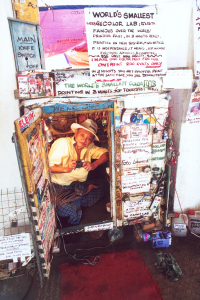
Then it was off to the dark room, a wooden cubicle measuring approximately a square meter.
Here the seven frames of film he’d shot were removed from the camera and wound into the spiral core of his developing tank. Temperatures inside the room were frequently well in excess of one hundred degrees Fahrenheit which had a strong bearing on why the film developed so quickly. The optimum temperature for developing film is 68 degrees Fahrenheit over a period of ten to fifteen minutes depending on the variety of film stock used.
However the hotter the chemicals, the shorter the developing time, and Mr. Sein Win had it done in a flash. Developed, fixed, and dried with a hair dryer in about three minutes.
‘See,’ he said proudly, ‘no computer, no mini lab, just me and my developing tank.’
He had an un-canny ability to estimate the exposure and development times. He didn’t use a clock to time the exposures or a thermometer to measure the temperature of the developer.
Then, within another three minutes, just as the sign in the front of his cubicle promised, the prints were done to a turn.
While the emulsion on the surface of the paper was still soft, he etched a personal message onto the surface of the print with a nail before they were dried with a hair dryer and proudly presented to the satisfied customer. Each print cost a mere two hundred kyats ( about fifty cents ) and, while they were not the greatest photographic masterpieces the world has ever seen, the whole experience was a unique encounter with a very colourful character and an adventure that would not have been possible if all the images had been recorded digitally.
I took the photos of Mr Sein Win with my trusty Nikon FM 2 camera, using Kodak 35mm colour negative film. They were the last photos I took using film, and were used to illustrate a story I wrote about him that was published in the Bangkok Post, The Nation, and Australian Photography Magazine.